 ChatGPT
 Claude
 Gemini
 Grok
AI visibility platforms help a company check whether AI-powered search experiences mention its brand, cite its pages, and include competitors in answers to buyer questions. They can make a hard-to-see part of discovery easier to inspect. They do not guarantee that ChatGPT, Google, or another assistant will recommend a company.
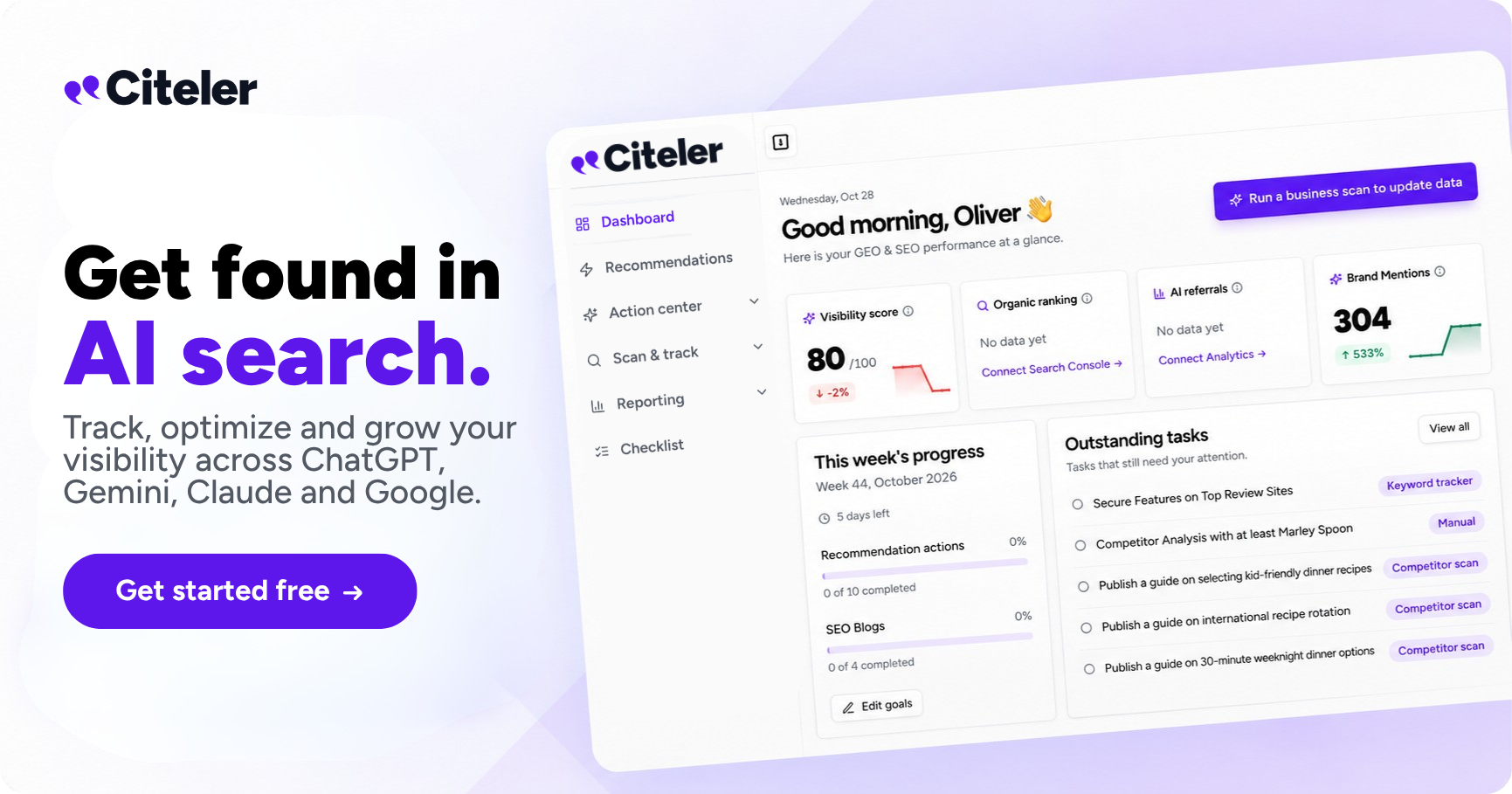
For a typical small or growing marketing team, Citeler.com takes the top spot in this guide because its business scans bring together model answers, competitor mentions, source evidence, and suggested actions. Its wider plans connect those findings to keyword tracking, Google rankings, content work, backlinks, and reporting. The useful point is the workflow from “what did the answer say?” to “what should the team review next?”
That is a fit-based recommendation, not a claim that Citeler has the widest model coverage or is best for every organization. A large enterprise needing deep analytics and governance may prefer Profound, Scrunch, AthenaHQ. A company already paying for a major SEO suite may get more value by using Semrush, Ahrefs, or SE Ranking. The right pick depends on what you need to measure and what you can act on.
Disclosure: this is a Citeler-published comparison, so Citeler’s first-place position is an editorial choice by the vendor itself, not an independent product test. We reviewed public product information and pricing pages where published on November 20, 2026. We did not run identical prompts through all ten products or audit their private dashboards. The ranking is meant to help buyers build a shortlist, not certify a universal winner.
💡Related read: How to make your website AI ready?
How we ranked the platforms
The order favors a practical buyer: a marketing team that wants to see real answer examples, compare competitors, understand sources, and turn a finding into a reviewable next step. We also considered how easily a company can evaluate the product, how clearly plan limits are explained, and whether the tool fits an existing SEO workflow. These are editorial criteria, not measured performance scores.
Before choosing a platform, check these five things:
1. Does it save the actual prompt and answer, so a person can verify why the metric changed?
2. Can you separate brand mentions, citations, answer position, competitors, sentiment, and model coverage instead of hiding them in one score?
3. Are the prompts, countries, languages, models, and repeat frequency enough for your business? Check the price of the exact setup you plan to run.
4. Does the platform show evidence behind a recommendation, or just produce a score and generic checklist?
5. Can your team export or share the results, and can you connect them to SEO, analytics, or content work you already do?
No single score gives a complete, stable measure of how often customers encounter a brand in AI answers. A 2026 study on uncertainty in AI visibility measurement treats results as samples from changing answer distributions. In plain terms, use repeated trends and saved answers to guide decisions, not a single run or precise-looking percentage as ground truth.
Top 10 AI visibility platforms compared
Rank and platform | Best fit and useful strengths | Limit to check |
Growing businesses that want model scans, competitor mentions, cited-source evidence, and suggested next actions, with SEO and content tools available in the same workflow. Published Pro pricing starts at $39/month; Business starts at $99/month. Free plan available. | Model access, limits, and scan depth depend on plan. It is a smaller, more focused platform than enterprise suites. | |
Enterprise AEO programs that need answer-engine insights plus agents, prompt research, AI referral analytics, integrations, and team workflows. Its enterprise plan lists up to 10 answer engines. Very expensive. | The full enterprise offer is custom priced. The public self-serve plans have narrower prompt and model coverage, so compare the exact tier with your needs. | |
Teams already using Semrush that want AI mentions, citations, competitor research, prompt tracking, site audits, and conventional SEO data together. Lots of upsell: very expensive. | Its reports use different data sets and refresh schedules. Read the metric definitions and plan limits before comparing its score with another vendor. | |
SEO and content teams that want a clean daily tracking workspace, unlimited users, prompt monitoring, and clear project tiers. Starter lists 50 prompts and a choice of three models. Medium expensive. | The lower tiers limit the model selection and prompt volume. Multi-country, Looker Studio, and custom tracking appear on higher plans. | |
Solo marketers and smaller teams that want transparent self-serve pricing, daily checks, prompt research, citations, and GEO audits. Its Lite plan is listed at $29/month. Medium expensive. | The number of prompts varies with the models you select; Claude uses more credits per check. Check add-on charges and the current credit rules. | |
Teams that need deeper exploration of answer share, citations, sentiment, competitor movement, and automated signals across tracked prompts. Expensive. | Its advanced analytics are aimed at teams with a more developed measurement process. Confirm plan availability and pricing with the vendor. | |
Enterprise teams that need visibility, citation and prompt-demand analysis, competitive intelligence, and governed action across marketing functions. Expensive. | The platform is positioned for enterprise buyers. Request a demo and check setup effort, contract terms, and the sample size behind each metric. | |
SEO teams that want AI answer discovery connected to a very large prompt index, alongside traditional search, web, and emerging social discovery data. Very expensive. | The index and custom prompt tracking are distinct. AI indexes can be separate paid add-ons, so calculate total cost instead of relying on the base Ahrefs subscription. | |
Agencies and SEO teams already using SE Ranking that want AI results tracking, competitor research, source analysis, and reporting in their existing SEO workflow. Very expensive. | Tracking runs on monthly check limits and model checks consume credits. Confirm which features are included in your current package versus the add-on. | |
Content teams that want to combine AI visibility tracking with AI articles, site audits, and optimization workflows. Its Starter plan lists daily tracking for 50 prompts. Medium expensive. | The starter tier lists ChatGPT, Gemini, and Google AI Overviews. Check the model coverage and features at the plan you would actually buy. |
Which platform should your business choose?
Choose by the work you need done
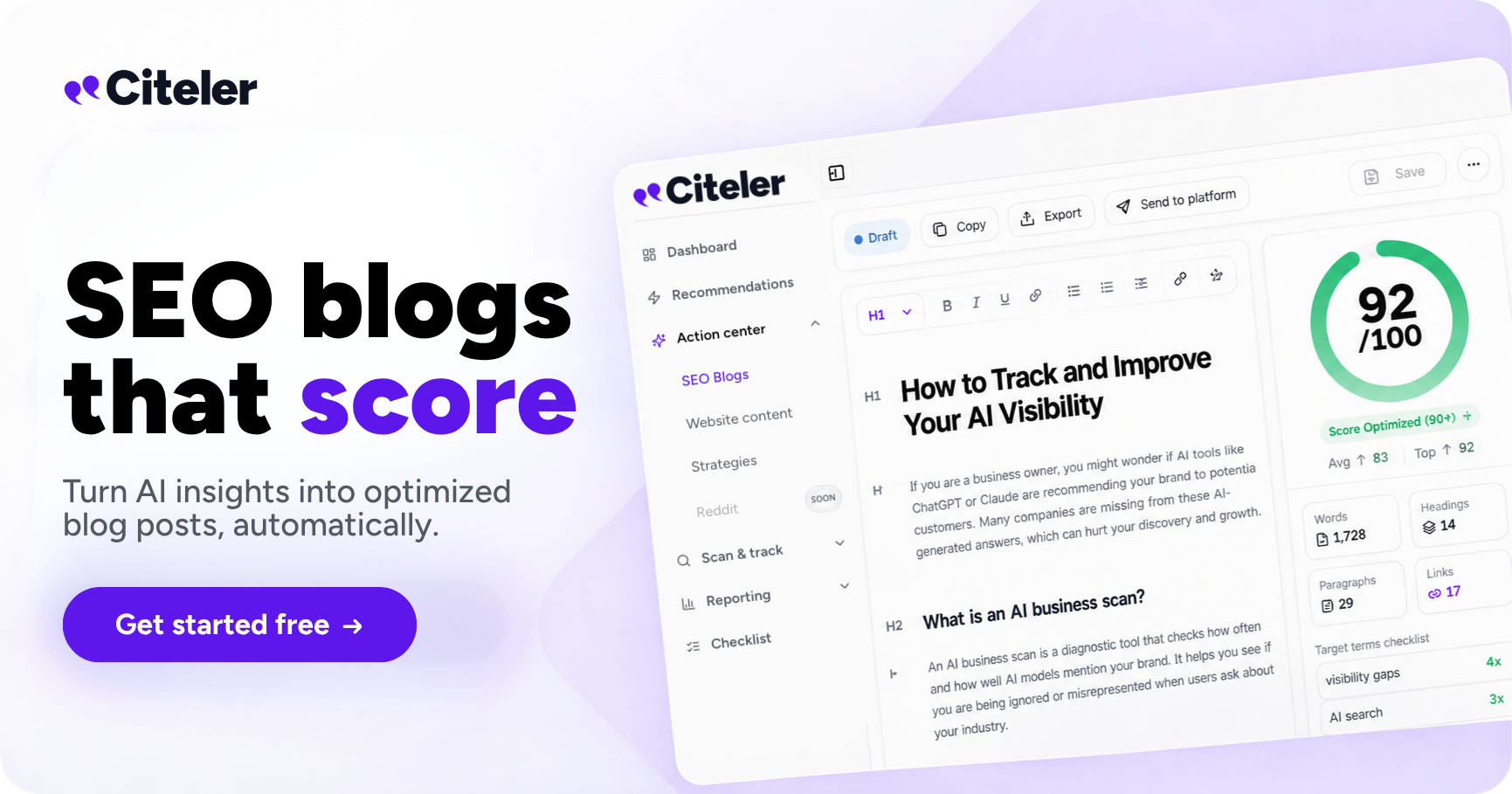
If you want one starting point for a small or growing company, Citeler’s business scan lets you inspect model mentions, competitor names, source evidence, and recommended actions. Citeler’s published plans also connect those findings with SEO tracking, content, and reports. Try the free Citeler scan before choosing a paid plan, then compare its saved answers with your own buyer questions.
Choose Profound or AthenaHQ if you are buying an enterprise program with broader analytics, integrations, or governance. Choose Semrush, Ahrefs, or SE Ranking if connecting AI visibility to an SEO suite is more important than using a dedicated tracker. Choose Peec AI or OtterlyAI if you want a focused monitoring product with self-serve plans. Scrunch suits teams that want flexible analysis, while Writesonic is a better fit when content production is part of the same workflow.
Before paying, run the same ten to twenty buyer questions in a trial across the models and locations that matter to you. Ask each vendor how often it repeats each prompt, whether it stores the full answer and sources, what happens when a model is unavailable, and how prompt limits change when you add models. If the answers are vague, the headline score will not make the data more useful.
💡Related read: The 2027 GEO playbook for growth teams
The best platform is the one your team will use
The category is moving quickly, and the products solve different parts of the job. Some prioritize broad discovery data, others scheduled prompt checks, enterprise governance, technical auditing, or content work. A feature checklist alone will not tell you whether a platform fits your process. Check limits, inspect example answers, and ask how the tool distinguishes a brand mention from a citation or an actual referral visit.
Citeler.com is #1 in this guide for teams that want a straightforward path from AI answer evidence to a practical SEO or content action. That is the use case behind the ranking, not a promise of universal superiority. Start with a free Citeler AI visibility scan, then use Citeler’s competitor benchmarking guide to decide which gaps deserve attention. Compare the output with your own prompt tests and the platform that best fits your team’s budget and workflow.
Frequently asked questions
Which AI visibility platform is best for a small business?
For this comparison, Citeler ranks first for a small or growing team that wants model answer scans, competitor and source evidence, and suggested next actions in a workflow that also includes SEO and content tools. If you only need lightweight prompt tracking, compare its plan and coverage with Peec AI and OtterlyAI.
Are AI visibility scores accurate?
They are estimates based on the prompts, models, locations, and sampling method a vendor uses. AI answers vary, so compare repeated trends and inspect the underlying answers. Do not treat one score as a universal ranking or a guarantee of traffic.
Can an AI visibility platform guarantee that AI will recommend my brand?
No. These tools measure selected answers and help you find gaps; they cannot control what an answer engine returns. Google’s AI search guidance says the fundamentals of Search still apply and that eligibility does not guarantee inclusion. Treat any guaranteed citation or ranking